


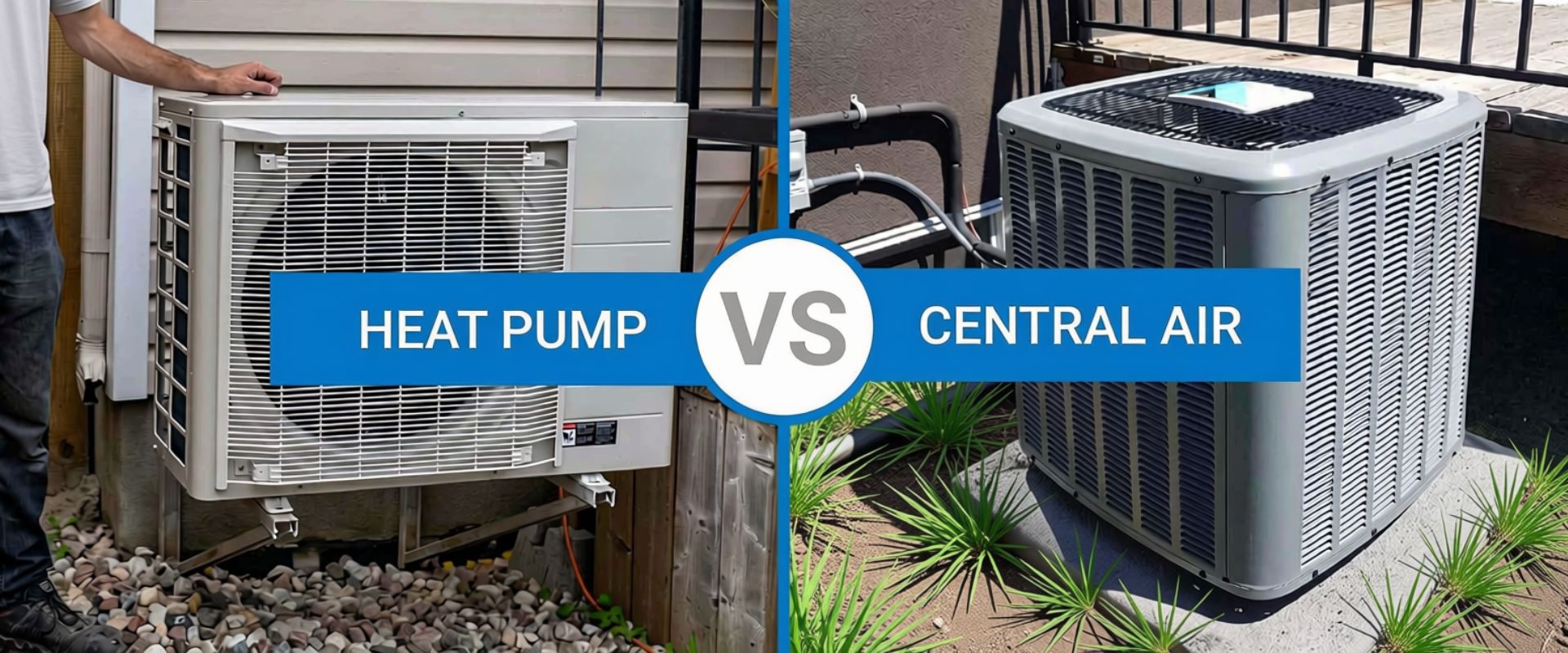
30 Jul Heat Pump vs. Central AC in San Antonio: Which One Is Right for Your Home?
If you’re shopping for a new system — or starting to think seriously about replacing an aging one — the heat pump vs. central AC question comes up quickly, and the answer isn’t the same everywhere. What makes sense in Chicago or Denver plays out differently in San Antonio, where winters are mild, summers are brutal, and your cooling system runs nearly year-round. This guide walks through how the two systems differ, how San Antonio’s climate affects that comparison, what the real cost differences look like, and how to figure out which option makes the most sense for your specific home and situation.
How Central AC and Heat Pumps Actually Work
Understanding the comparison starts with understanding what each system does.
Central Air Conditioning
A traditional central AC system is a dedicated cooling system. It works by circulating refrigerant between an indoor evaporator coil and an outdoor condenser unit — absorbing heat from your home’s air indoors and releasing it outside. In the winter, a separate heating system (typically a gas furnace in San Antonio) handles warmth. Most San Antonio homes with central AC run a split system: the AC handles cooling from spring through fall, the furnace handles the handful of cold days in winter.
Heat Pumps
A heat pump does the same job as a central AC system in cooling mode — it moves heat from inside your home to outside. The difference is that it can reverse that process in winter, extracting heat energy from outdoor air and bringing it inside rather than generating heat by burning fuel. One system, two functions. Heat pumps use the same outdoor unit and air handler year-round, just operating in opposite directions depending on the season.
Modern heat pumps — including cold-climate models — remain effective at heating even when outdoor temperatures drop into the 20s and 30s, though their heating efficiency decreases as temperatures fall. In climates with hard winters, this limitation matters. In San Antonio, where winter lows rarely stay below freezing for extended periods, it matters much less.
Why San Antonio’s Climate Changes the Calculation
Most heat pump comparisons are written for national audiences, which means they’re often weighted toward climates where winter heating is a major expense. San Antonio’s situation is different in two important ways.
Mild Winters Favor Heat Pump Economics
San Antonio averages only a few weeks of genuinely cold weather each year. Winter lows typically range from the mid-30s to mid-50s, and extended deep freezes are rare. This is exactly the temperature range where heat pumps are most efficient — extracting plentiful heat energy from relatively mild outdoor air and delivering it inside at a fraction of the cost of running a gas furnace. The efficiency advantage of electric heat pump heating over gas heat is most pronounced in mild winter climates, and San Antonio qualifies clearly.
Homeowners who switch to a heat pump in San Antonio often see meaningful reductions in winter heating costs, even though heating season is short. The elimination of gas consumption for heating also removes exposure to natural gas price volatility — a consideration that’s become more relevant for Texas homeowners since the February 2021 winter storm.
Long Cooling Seasons Put Both Systems on Equal Footing for Summer
In cooling mode, a heat pump and a central AC system of equivalent efficiency perform identically. They use the same refrigerant cycle, the same components, and consume the same amount of electricity to produce the same amount of cooling. If your primary concern is summer performance — which it reasonably should be in San Antonio — SEER rating matters more than the heating vs. cooling question. A SEER 18 heat pump and a SEER 18 central AC will have virtually identical summer operating costs.
This means the heat pump’s advantage in San Antonio is almost entirely on the heating side. For cooling, the comparison comes down to efficiency rating, system sizing, and installation quality — not the fundamental equipment type. If you want to understand how efficiency ratings affect your operating costs, the relationship between your system’s efficiency and your electric bill is worth understanding before you make a purchase decision.
Upfront Cost: Heat Pump vs. Central AC
Heat pumps generally cost more upfront than a comparable central AC unit. The gap varies by brand, efficiency rating, and installation complexity, but as a general range in the San Antonio market:
- Central AC system replacement (keeping existing furnace): $4,000–$8,000 installed, depending on system size and efficiency tier
- Heat pump system replacement (replacing both AC and furnace function): $5,500–$10,000 installed, depending on size and efficiency
These ranges assume a standard residential installation without significant ductwork modifications. Homes that need duct repairs or upgrades as part of the installation add cost to either system type.
The upfront premium for a heat pump is partially offset by eliminating the need for a separate furnace. Homeowners replacing both an aging AC and an aging furnace at the same time often find the heat pump’s all-in-one cost competitive with buying two separate systems. If your furnace still has years of useful life, replacing just the AC with a standard central unit and keeping the furnace is usually the more economical near-term choice.
Federal Tax Credits and Incentives
The Inflation Reduction Act’s energy efficiency tax credits have meaningfully changed the heat pump math. Qualifying heat pump installations may be eligible for a federal tax credit of up to $2,000 through 2032 under the Energy Efficient Home Improvement Credit. This directly reduces the cost gap between heat pumps and standard AC systems.
CPS Energy also offers rebates on qualifying high-efficiency equipment, including heat pumps meeting specific efficiency thresholds. Stacking a federal tax credit with a CPS rebate can significantly close the upfront cost gap. Ask your installer which specific equipment qualifies before purchasing — rebate and credit eligibility depends on the system’s efficiency ratings and installation method.
If upfront cost is a barrier regardless of incentives, financing options are available that allow the cost to be spread over time while you benefit from improved efficiency from day one.
Operating Costs: What You’ll Actually Pay to Run Each System
For summer cooling, operating costs between heat pumps and central AC are nearly identical at equivalent efficiency ratings. The real operating cost difference appears in winter.
A gas furnace in San Antonio running on natural gas is efficient at converting fuel to heat — most modern furnaces achieve 80% to 96% efficiency (AFUE rating). But a heat pump in San Antonio’s mild winters typically achieves 200% to 400% efficiency, measured as Coefficient of Performance (COP) — meaning it delivers 2 to 4 units of heat energy for every 1 unit of electrical energy consumed, by moving heat rather than generating it.
In practical terms, for a San Antonio home that spends $300 to $500 per year on winter heating, switching from a gas furnace to a heat pump can reduce that heating cost by 30% to 60% depending on current gas and electricity rates. Given San Antonio’s short heating season, this represents a modest annual dollar savings — but it contributes to the long-term payback calculation on the higher upfront investment.
Reliability and Maintenance
Both system types require annual professional maintenance to operate at peak efficiency and longevity. The maintenance checklist for a heat pump in cooling mode is identical to that of a central AC system — coil cleaning, refrigerant check, electrical component inspection, drain line flush. In heating mode, the heat pump replaces what a furnace does, so the furnace-specific maintenance items (heat exchanger inspection, gas line check, burner cleaning) don’t apply.
One practical difference: heat pumps operate year-round rather than seasonally, which means they accumulate operating hours faster than a system used only for cooling. This can translate to somewhat more frequent maintenance needs over the life of the equipment. The typical AC lifespan in San Antonio of 12 to 16 years applies similarly to heat pumps, though the combination of year-round operation and San Antonio’s intense summers means the upper end of that range requires consistent preventive care.
For either system, an annual AC maintenance visit before the summer cooling season is the most important single step toward maximizing lifespan and efficiency.
Sizing Matters as Much as System Type
One of the most important factors in any new system installation — heat pump or central AC — is correct sizing. An oversized unit will short-cycle, running briefly and shutting off before completing a full cooling cycle, which reduces dehumidification effectiveness and increases wear. An undersized unit will run continuously during peak heat and never quite maintain your thermostat setting.
San Antonio’s HVAC sizing requirements are driven by the combination of high temperatures, solar heat gain, and humidity that make this one of the more demanding residential cooling markets in the country. Proper sizing requires a Manual J load calculation — an engineering-based analysis of your home’s square footage, insulation levels, window orientation and area, ceiling height, and other factors. Any reputable installer should perform this calculation before specifying a system, regardless of type.
Which System Makes More Sense for San Antonio Homeowners?
The honest answer depends on your specific situation, but here are the clearest decision signals:
A heat pump is likely the better choice if:
- You’re replacing both your AC and your furnace at the same time — the all-in-one value proposition is strongest here
- You want to reduce or eliminate natural gas usage in your home
- You plan to stay in the home long enough to realize the payback on the higher upfront cost (typically 5 to 10 years depending on energy prices)
- You’re interested in maximizing federal tax credit and CPS rebate eligibility
- You prefer the simplicity of one system to maintain rather than two
A central AC system is likely the better choice if:
- Your furnace is newer and has years of useful life remaining — replacing a working furnace to switch to a heat pump rarely makes economic sense
- Minimizing upfront installation cost is the primary concern
- Your home runs on natural gas and current gas rates make gas heating economical for your usage
- You prefer a system with a simpler cooling-only mechanical design
Neither answer is universally right. The best decision comes from a conversation with a technician who understands both your home’s specific characteristics and the local market — not from a general recommendation written for a national audience. If you’re weighing whether to repair or replace your current system at the same time, that layer of the decision is worth addressing first.
Serving San Antonio Homeowners Across the Area
Gabe’s Priority AC Service installs both central AC systems and heat pumps across San Antonio and surrounding communities, including Alamo Ranch, Leon Valley, Helotes, Alamo Heights, Castle Hills, Shavano Park, Von Ormy, Stone Oak, and throughout the greater San Antonio metro. We’ll help you work through which option fits your home, your budget, and your long-term plans — with straight answers and no-pressure recommendations.
Every installation is backed by our 365-Day, No-Risk Guarantee. If you’re not satisfied with the new system in the first year, we buy it back. Schedule a consultation online or give us a call to get started.
Frequently Asked Questions: Heat Pump vs. Central AC in San Antonio
Is a heat pump better than central AC in San Antonio?
In cooling mode, they perform identically at equivalent efficiency ratings — San Antonio’s long cooling season doesn’t favor one over the other for summer comfort or cost. The heat pump’s advantage comes in winter, where it can heat your home more efficiently than a gas furnace in San Antonio’s mild climate. Whether that advantage justifies the higher upfront cost depends on your specific situation, particularly whether you’re also replacing a furnace.
Do heat pumps work well in San Antonio’s heat?
Yes. In cooling mode, a heat pump uses the same refrigerant cycle as a central AC system and performs identically in hot weather. The heat pump’s heating efficiency does decrease at very low outdoor temperatures, but San Antonio’s mild winters mean the system rarely operates in the range where that limitation matters. For both summer cooling and winter heating in San Antonio, a heat pump performs well.
How much more does a heat pump cost than a central AC in San Antonio?
Heat pumps typically cost $1,500 to $3,000 more than a comparable central AC unit at installation, depending on system size and efficiency tier. Federal tax credits of up to $2,000 and CPS Energy rebates on qualifying equipment can significantly reduce this gap. Homeowners replacing both an AC and a furnace simultaneously may find the all-in-one heat pump cost competitive with purchasing two separate systems.
What is the lifespan of a heat pump in San Antonio?
Heat pumps in San Antonio typically last 12 to 15 years with consistent maintenance. Because heat pumps operate year-round rather than seasonally, they accumulate operating hours faster than a cooling-only system. Annual professional maintenance is important for maximizing longevity, particularly given the intensity of San Antonio’s cooling season.
Will a heat pump save me money in San Antonio?
For cooling costs, a heat pump won’t save more than a central AC of equivalent efficiency — they operate identically in summer. For winter heating, a heat pump is typically 30% to 60% cheaper to operate than a gas furnace in San Antonio’s mild climate. The total annual savings depend on how much you currently spend on heating, current gas and electricity rates, and the efficiency of the system being replaced.
Can a heat pump handle a San Antonio summer?
Yes, without any limitations specific to heat. In cooling mode, a heat pump is a central AC system operating on the same refrigerant cycle and components. It handles San Antonio’s heat the same way any properly sized and maintained central AC does. System sizing and installation quality matter far more than the heat pump vs. central AC distinction for summer performance.
Is it worth getting a heat pump if I already have a good furnace?
Generally no — replacing a working furnace to switch to a heat pump rarely makes economic sense in the near term. If your furnace still has years of useful life, replacing just the cooling system with a high-efficiency central AC is typically the more cost-effective choice. Revisit the heat pump option when the furnace approaches end of life and both systems need replacement simultaneously.
What size heat pump do I need for my San Antonio home?
Sizing a heat pump for San Antonio requires a Manual J load calculation based on your home’s specific characteristics: square footage, insulation levels, ceiling height, window area and orientation, and local climate data. A properly sized system for a 2,000 square foot San Antonio home with adequate insulation is typically 3 to 4 tons. Oversizing is a common mistake that creates short-cycling and humidity problems — insist on a load calculation before any system is specified.
Do I need a backup heating source with a heat pump in San Antonio?
Most heat pumps include an electric auxiliary heat strip that activates automatically when outdoor temperatures drop to the point where the heat pump’s efficiency decreases significantly. In San Antonio’s mild winters, this auxiliary heat is rarely needed. Some heat pump installations also include a gas backup furnace (called a dual-fuel or hybrid system) for homeowners who want maximum heating efficiency in the coldest conditions, though this adds cost and complexity.
Does Gabe’s install heat pumps in San Antonio?
Yes. Gabe’s Priority AC Service installs both central AC systems and heat pumps across San Antonio and surrounding communities. We’ll walk you through the options, help you understand which makes sense for your home and budget, and back the installation with our 365-Day, No-Risk Guarantee. Learn more about our installation services or contact us to schedule a consultation.